
You Paid a Big Agency for Video. So Why Are You Disappointed?
INTRODUCTION
In a recent conversation, I heard a story I have heard more than once.
A well-known national video agency was hired to produce a brand video. The agency had offices in multiple major cities. The crew showed up with professional gear. The invoice was significant. On paper, everything right.
Then the shoot started, and she and a coworker found themselves directing it. Not creative input. Directing.
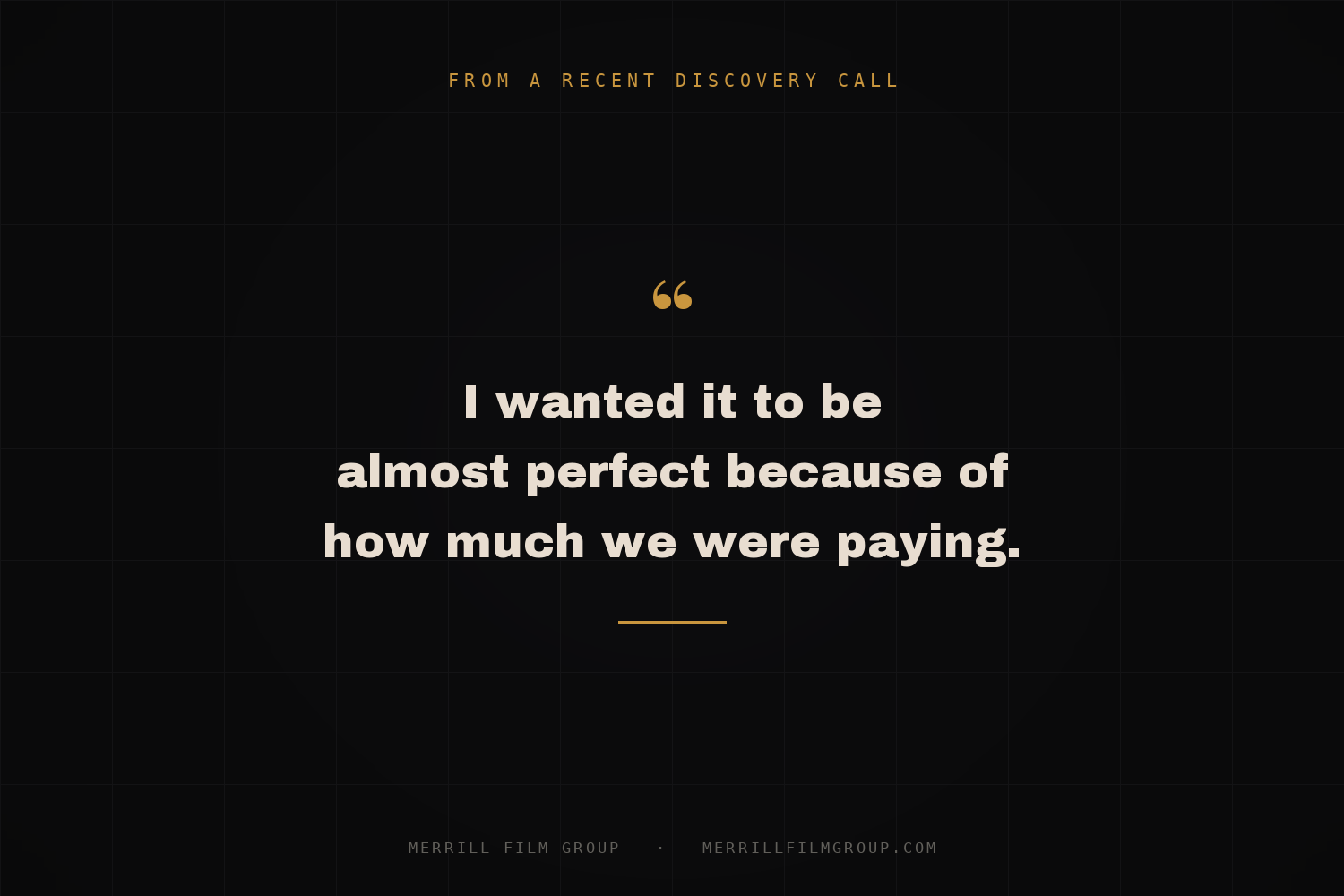
Her takeaway stuck with me: “I wanted it to be almost perfect because of how much we were paying."
Before I go further, I want to be clear about something. I have worked with some amazing agencies, and I came up through agency work myself. This post is not about bashing agencies. It is about a simpler truth that catches a lot of companies off guard: a higher price does not always mean better work or a better experience.
That is the part worth talking about. Because the problem was never her expectations. The problem is what happens inside some big agency projects, and how to know what you are actually buying.
THE STORY I KEEP HEARING
Some version of this story comes up in discovery calls constantly, and it almost always follows the same arc.
A company decides to invest seriously in video. They want it done right, so they go with the biggest name they can afford. The pitch process is impressive. The people in the room are sharp. Everyone feels good about the decision.
Then the project starts, and the experience quietly changes. Communication slows down. The team from the pitch is nowhere to be found. The company starts doing work they assumed they were paying the agency to do. And when the final product arrives, it is fine. Just fine. Not the piece they imagined when they signed the agreement.
Nobody got scammed. The video technically got delivered. But if you spent that much and feel like you had to manage the project yourself to get an acceptable result, that is not a successful project. A successful project is one where the result and the experience both match the investment.
WHY THIS HAPPENS AT BIG AGENCIES
This is not about big agencies being bad at what they do. Plenty of them produce excellent work. It is about how the model works, and what that model means for accounts that are not at the top of the client list.
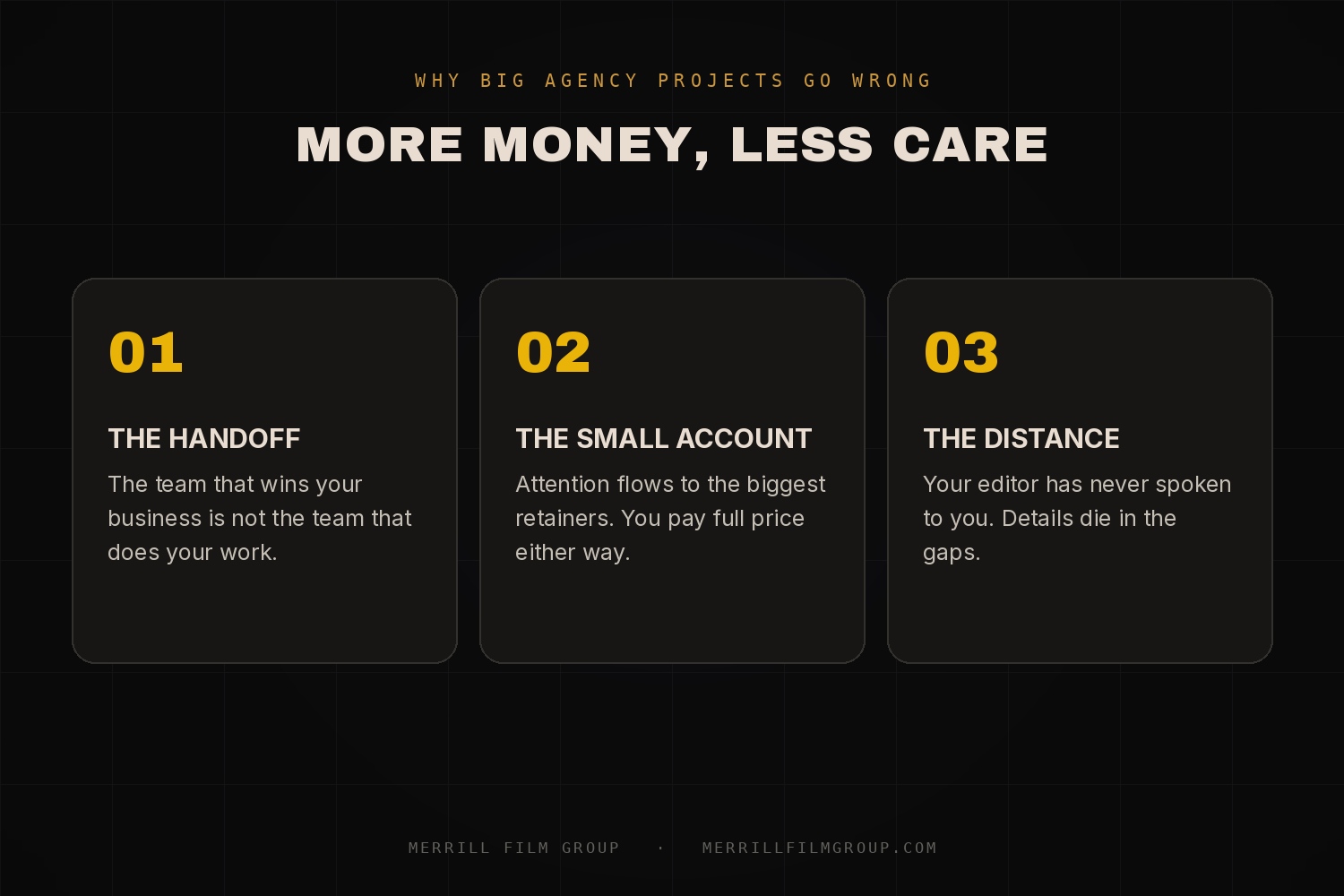
The people who win your business are rarely the people who do your work. Agencies put their best in the room to close the deal. Once the agreement is signed, the project gets passed down, and the talent level that sold you is not the talent level that shows up on set.
You are probably not their biggest account. A large agency's attention flows toward its largest retainers. If your project is not one of them, your project gets whatever focus is left over. You pay top dollar either way.
Care does not scale. The person editing your video at a large agency has likely never spoken to you. They are working from a brief, three layers removed from the conversation where you explained what this video actually needs to do for your business. Details fall through those gaps, and the details are usually what separate a video you love from a video you tolerate.
THE FALSE CHOICE MOST COMPANIES THINK THEY HAVE
When companies get burned like this, or hear enough stories like it, they usually conclude they have two options.
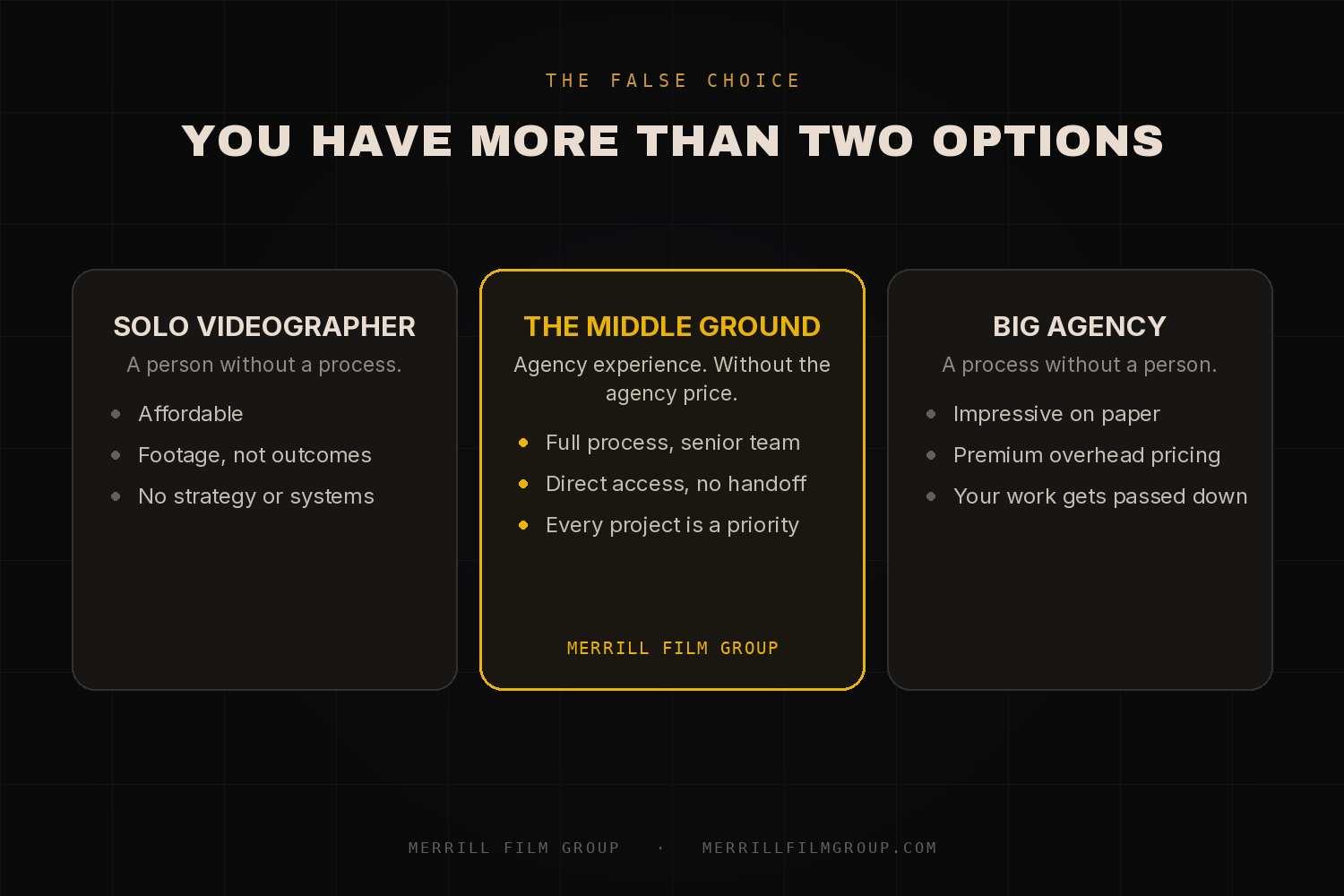
Option one: hire a solo videographer. More affordable, but often a mixed experience. Many are talented shooters who do not offer strategy, messaging, project management, or a real revision process. You get footage. You do not always get an outcome.
Option two: hire a big agency. Full service and impressive on paper, but you pay a premium for overhead, and as we just covered, the size that makes them impressive is the same thing that makes it hard for them to care about your project specifically.
Most companies bounce between these two options and end up unhappy with both. One gives you a person without a process. The other gives you a process without a person.
There is a third option, and it is where I have built my entire business.
THE MIDDLE GROUND: AGENCY EXPERIENCE WITHOUT AGENCY PRICE
The middle ground is a small, senior production partner. A team big enough to run a full-service process, strategy, pre-production, production, post, and delivery, but small enough that the person you met on the first call is the person directing your shoot and reviewing your final cut.
This is exactly how Merrill Film Group is built, and it is intentional.
The person who sells you is the person who serves you. There is no handoff to a B-team, because there is no B-team. I am on your discovery call, I am building your strategy, I am directing your shoot, and I am accountable for what gets delivered. Nothing gets lost between the promise and the product.
Client experience is the product. A great final video matters, but so does everything around it: clear communication, a process you can follow, being directed on set instead of doing the directing. You should never have to tell your production crew what shots to get. That is what you hired them for.
You get agency-level deliverables without agency-level overhead. A full engagement, brand story film, trailer cut, short-form content, banner video, runs a fraction of what a national agency charges for the same scope, because you are not paying for office space in three cities or layers of account management between you and the work.
Your project is never the small account. When your roster is intentionally small, every project is a priority project. That is not a slogan. It is just math.
-
It usually comes down to the handoff. The senior team that wins the account passes the work to less experienced staff, and smaller accounts get less attention than large retainers. The client ends up managing quality themselves, which is exactly what they paid the agency to handle.
-
Sometimes, but know what you are buying. Many solo videographers are excellent shooters who do not provide strategy, messaging development, project management, or a structured revision process. If you need a business outcome and not just footage, look for a partner who runs a full process.
-
A full package, including a brand story film, a trailer cut, short-form content, and a website banner video, typically runs around $10,000 with a smaller production partner. A comparable scope at a national agency often runs several times that. Price alone does not predict quality. The structure of the team behind it does.
-
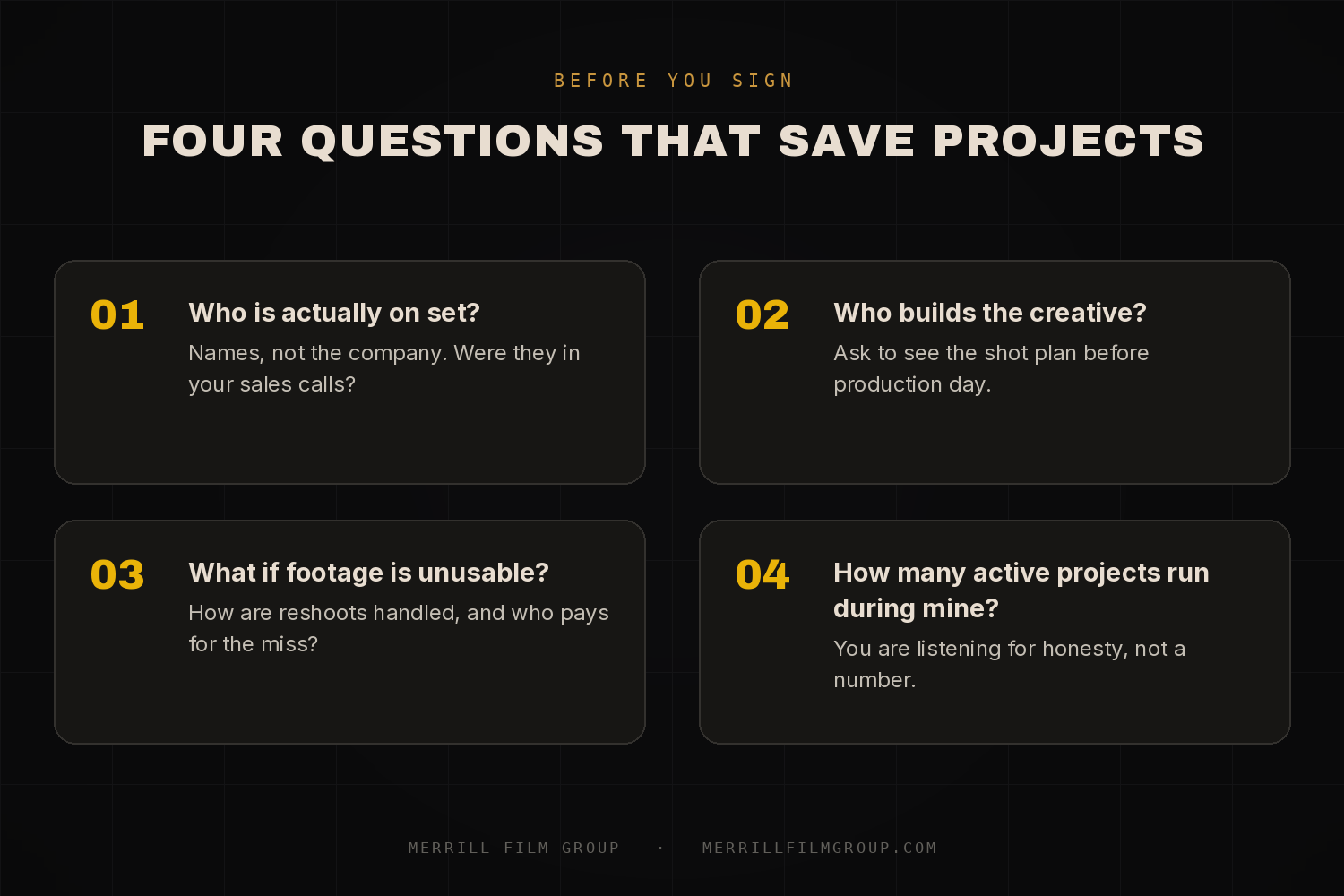
Ask who will actually be on set, who translates your vision into a shot plan, how unusable footage and reshoots are handled, and how many projects the team runs at once. The answers tell you whether you are hiring the people in the room or a brand name with a rotating cast behind it.
CONCLUSION
Spending more does not guarantee a better video. It guarantees a bigger invoice.
What actually predicts a great result is simpler: the people who understood your story being the same people who capture it, a process that carries your vision from the first call to the final cut, and a partner whose business depends on your project going well, not just closing.
If you have been burned by a big agency, or you are trying to avoid becoming the next version of this story, let's start a conversation.